Sydney, Australia, Homebuilt Rebreather Capitol of the World.
Being isolated from the rest of the world Australian divers have always had to be self sufficient.
From the early diving days of home made wetsuits, twin hose regs and other gear, Australian divers have
always had a pioneering spirit. It is no wonder then that Sydney Australia is home to more homebuilt rebreathers
than anywhere else in the world.
While it has been said that these devices are "the future of diving" and "wonders of modern technology",
they are in fact a reinvention from the past and were around many years before scuba was invented.
Why build your own rebreather? Why not!
The concept is a fairly simple one and, compared to building your own demand valve regulator a rebreather is quite simple in construction.This is not to say that it is easy or should even be attempted by anyone but the most dedicated and conscientious dive fanatic. In fact, without the proper knowledge and understanding of what you are doing it should not even be considered. The potential for disaster is enormous. Just look at the Space Shuttle, a technical marvel, each component individually machined and checked, but one faulty o-ring and...boom! Once you have built one it is another matter diving with one and without a thorough understanding of gas properties, physics and physiology you will probably not survive even one dive. These are, after all, life support systems in an environement where hypoxia, hyperoxia and hypercapnia are unforgiving. Never the less, in the last 18 months three homebuilt rebreathers have been constructed and dived by a group of Sydney enthusiasts and a number of others have units 'under construction'. The dives have ranged from 6m shore dives on closed circuit using oxygen, to 20m dives semi-closed using nitrox, to dives on the P.S. Koputai in 78m and other deep wrecks and reefs, closed circuit using trimix and heliox.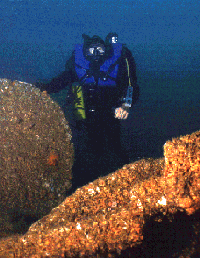
Rod Nairne's Rebreather on the Birchgrove Park wreck in 51msw.
After diving on a rebreather the underwater world is never the same again.
Fish life is abundant on dives that are mundane and appear barren on open circuit scuba. On a rebreather these sites come to life with fish interaction that can only be experienced on a 'breather'. The only problem is you need to dive with another rebreather diver as anyone in the near vicinity on o/c scuba sounds like a steam train and will scare all the fish. With a rebreather the ocean truly is 'the silent world' and you hear sounds of crustaceans, sea life and other things that you have never heard before.Another plus is the conservation of gas. On a 70min dive at Camp Cove I used only 20bar from a 63cf tank and half of that probably went into inflating my drysuit. While fishlife at this site is usually good we saw it like never before. A school of about thirty Blackfish, which usually bolt when they see scuba divers approaching, were within an arms length and totally oblivious to us. We also had a school of squid feeding only feet from us. On deeper dives the conservation of inert gas, such as helium, amounts to big dollar savings. A regular dive on trimix would cost over $100 in gas but on a rebreather it costs only a tenth as much.
While the parts needed to 'do it yourself' are not expensive, sourcing them is very time consuming and building the unit can be as frustrating as it is rewarding and takes many hours of time in both design and construction. The variety of design choices is also large, proving there are many solutions to the same problem. As you begin construction you realise exactly how dangerous these things can be and you find that the knowledge nescessary to 'safely' dive a homebuilt rebreather is equivelent to the contents of an encyclopedia and then some. Bailout options must be well considered before attempting even a shallow dive, and testing and checking must be thorough during all stages of construction. A much safer option for most would be to buy a commercially available unit such as the Atlantis and receive training from an instructor who has many hours of practical diving experience on the unit, however, this isn't as much fun as turning up to a dive with an assortment of plumbing supplies on your back.
Check out some post dive photos of our rebreathers.
 After the Dive -Above water shots
Ask the A.A.R.G.

Click here to go  Back to Main Page
