Go to modern view
Rebreathing at Home
Richard Taylor's interview with Rodney Nairne
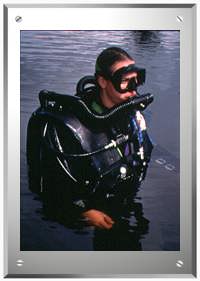 Nairne explained that deep open-circuit diving consumed large quantities of expensive mixed gas. A closed-circuit rebreather conserved inert gas, reduced narcosis through the use of helium mixtures and made longer deep dives practical. Commercial units were both difficult to obtain and unlikely to suit his preferred gas-switching and manually controlled approach, so he built his own.
Building and testing
Most major components were built rather than borrowed. Nairne stressed the need to understand gas laws and generic rebreather operation, warning that a little knowledge could be dangerous. The first unit went from drawing board to water in roughly a month, followed by continuing development and incremental improvements.
Monitoring and bailout
The diver monitored oxygen partial pressure frequently, especially around depth changes. Open-circuit access to carried gases and sufficient bailout to reach the surface provided the principal redundancy.
Experience and training
Nairne cautioned that closed-circuit diving added complexity and should not replace solid deep open-circuit skills. He recommended experienced, unit-specific instruction and careful scrutiny of an instructor's qualifications and practical rebreather experience.
The recovered photograph was captioned by the source as Suzie Dudas modelling the Nairne fully closed rebreather.
 Back to the AARG Topgun page