Dive Report: July '98
Rod and Suzie's U.S.A. trip.
Australian Homebuilt CCR's on the 'RMS' Republic and the 'Andrea Doria'.

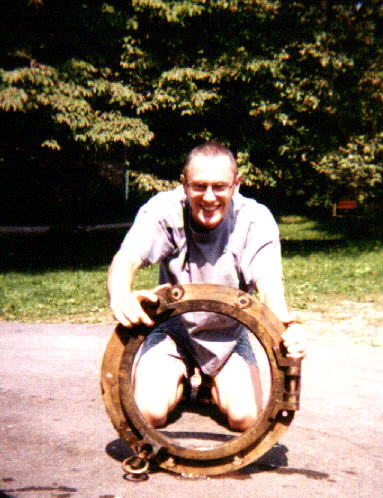
Rod with a porthole he recovered from the Republic
Our 1st dive was a checkout dive at Dutch Springs, a flooded quarry. Just in case we needed to acclimatise to cold water diving, and check out our trim for out upcoming dives off Montauk on the RMS Republic. Nothing special to note, the water temp was 10 C and we were in the water for 100 minutes.
Having use of the Dudas Diving Duds store made our gas mixing for the Republic trip easy; with the aid of the haskel gas booster we were able to get full pressure heliox 18 fills in our steel 72 cylinders, as well as boosting the pony bottles to 2500psi of oxygen. For the 2 of us then I mixed 2 72's of heliox 18, 2 72's of nitrox 50, and 2 pony bottles of pure oxygen. We also had a 3000psi 80cf tank of oxygen for top ups on the pony's, as well as for emergency in water deco on open circuit.
We had a 6 hour drive to the dock where we met up with the charter vessel Seeker. The Seeker has a long history in NE wreck diving and is run by it's second owners Dan Crowell and Jennifer Samulski. The second captain aboard for the trip was John Chatterton, crew was Pete Wohlleben, and Greg Mossfeldt, divers were John Yurga, Bonnie Merkel, Richie Kohler, William Cleary, Pat Rooney, Peter Hess, Joe Ferrali, Mike Trapani, and Jeff Schwartz.
We arrived at the Republic site later than expected due to strong winds the night before, so only 1 dive was made the 1st day. The Republic is a 570 foot long steam ship, a White Star Line Passenger vessel the victim of a collision in 1908. Of special note was than the Republic was the 1st shipwreck where radio was used to successfully summon assistance. The Smithsonian Institute alledgedly offered prior salvors $250 000 for the telegraph key if recovered. Also, the ship is rumoured to have been carrying $30 million dollars worth of gold eagles, 1908 value. For this reason the Republic site has been commercially salvaged several times, using saturation diving techniques. No gold and only a small fraction of the ships fittings/cargo has been recovered.
To our knowledge we were only the second or third group of recreational divers to visit the site; being only 7 miles from the popular wreck of the Andrea Doria, and a deeper dive, most divers are drawn to the larger Italian vessel where recovery of china a common place event.
We warmed up our scrubbers for about 10 minutes before the dive, and started out with a PO2 of around 0.4 to avoid any oxygen spikes on the descent to 250 feet with heliox 18. (Normally we run a diluent with 10% oxygen, and start the descent with close to 100% oxygen in the loop). Arriving on the bottom after we tied off our reel and started swimming along the wreckage. Unfortunately we ended up picked into the debris field off to the side of the wreck, a fact only evident when after reeling out about 150 feet of line, the huge ribs of the hull became visible.
Due to either a strong sense of survival or cowardice we decided not to swim around the wreck without the pace hindering reel. According to the saturation divers, the ship lies very flat with only 18 inches between decks, and massive hull plates obscure any hope of navigating along the sides of the vessel. The only artifacts we saw were a few portholes (we managed to recover 1 of these, as did 1 other diver). Suzie also spotted a few nice sized lobsters, one a possible 15 pounder.
That night we had to moor on the Andrea Doria wreck site, and the consensus of the divers was to stay in place the next day and dive the Doria. Although I had a strong urge to go back to the Republic, Suzies mother I knew would be pleased with us diving the Doria. As it turned out, we had a nice tourist dive on this wreck, we swam down from the side of the ship to the bottom in search of the bridge area, the vis at the 255 foot bottom being only about 20 feet. 20 feet is not much on a 700foot wreck! With no luck locating the bridge or the compass stand from which Suzies Dad recovered the compass in 1967, we ascended slowly to the promonade deck, and swam aft to approximately half way along the wreck, on the way passing Gimbals hole. We were lucky today with a good 50 feet of vis at the 180-200 foot level.
Many of the veteran Doria divers returned from Gimabls hole with bags full of China, from a new hole located originally by Gary Gentile this season. Aparrently Gary remained tight lipped about where he was recovering the 1st class coffee cups but John Yurga located the same spot, a crack in the central stairwell at 205 feet.
As it turned out, Suzie was the 1st female to dive the Doria on a rebreather, a nice one-two for mother and daughter… Evie Bartram Dudas was the 1st female to dive the Doria with her husband, John Dudas.
For the tech-heads:
We used 72's 1 heliox 18 for diluent for the whole dive (with the breather we do "oxygen enriched heliox" deco's, no gas switches). The purpose of the 18% oxygen is so we can deco out on open circuit bottom mix to 70 feet, where we would switch to our other 72 filled with nitrox 50, in the event of a loop flood. The nitrox also is used for suit and BC inflation. We run a constant partial pressure of oxygen of 1 ata until 30 feet were we bump it up to about 1.3 to 1.4 ata. As it turned out, Suzie had to switch to the nitrox 50 at 30 feet after her loop flooded. The cause of the flood was a pinched 0-ring on the cannister.
Ask the Backyard Boys

Click here to go  Back to Main Page