
What is a Rebreather?
The Australian Amateur Rebreather Group

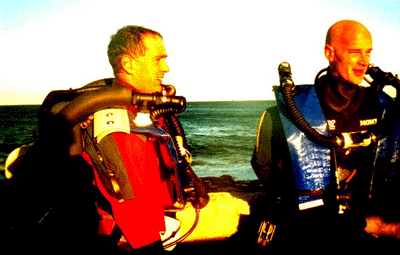 Conventional open-circuit scuba sends each exhaled breath into the water as bubbles. A rebreather keeps the breathing gas in a loop so it can be used again. Carbon dioxide is removed from the exhaled gas and oxygen is replaced as the diver consumes it.
Because the gas is recycled instead of discarded after every breath, a rebreather can make much more efficient use of a small gas supply. It can also greatly reduce, or in some cases eliminate, exhaust bubbles.
These replace the oxygen used by the diver with pure oxygen. Their design can be comparatively simple, but oxygen exposure restricts them to shallow water.
These add a premixed breathing gas to the loop and periodically vent part of the loop gas. They use less gas and produce fewer bubbles than open-circuit scuba, although their oxygen level can vary with the gas-addition method and the diver's workload.
These normally carry separate oxygen and diluent supplies. Oxygen sensors allow the unit or the diver to maintain a selected oxygen partial pressure while diluent maintains loop volume and provides the balance of the breathing mixture. In normal operation, very little gas is released.
A rebreather can continue to feel mechanically easy to breathe even when the gas in the loop is unsafe. Carbon dioxide removal, oxygen level, assembly, maintenance and bailout planning therefore demand more monitoring, training and discipline than ordinary open-circuit scuba. Different units can have very different procedures and failure modes.
This introduction is descriptive only. Rebreather diving requires suitable unit-specific training, maintained equipment and a practical bailout plan.
Australian Amateur Rebreather Group
 Back to Main Page