The D.E.A.D. Rebreather.
(Divers Euthanasia Assistance Device)

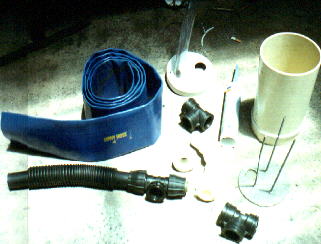
Bits of a rebreather under construction.
The DEAD is a manually operated, twin overshoulder counterlung type rebreather which can be dived CC on O2 and SC on Nitrox or Trimix. Electronics can easily be added to the unit to provide CC operation at all depths with any gasses. The design is based on an original unit made by Rod Nairne. His unit has been well developed to include electronics, a mouthpiece that can be shut off, custom machined fittings, a solid housing and various other additions. In contrast, these units have been made from materials and parts readily available from any good plumbing supplier and only just cross the line as 'life support systems'.
The 'Jason' Bags.
Jason Rogers originally came up with the idea for the breathing bags so in the tradition of the Gavin Scooter, Hogarthian Rig and other things named after their designer we have called these the JASON BAGS. They are made from a readily available material which is a plastic/rubber coated mesh which is hard to cut or damage.The ends are clamped with stainless . Jason has used PVC plates instead of stainless and had to fold the ends over to get a seal. Gas addition is via drysuit inflate valves on the bags. Exhale side for O2, inhale side for diluent, plug and play, just press the little button to add gas. Jason's unit has a demand valve addition system which consists of a regular scuba regulator attached to the inhalation side Jason bag.
Gas is dumped using a specially designed manually controlled variable rate valve.....ie.your nose. When diving semi closed you must calculate how often you need to dump gas based on depth, O2% in gas, lung volume, etc. Despite the popular 'Russian Roulette' theory of electronic rerbreathers, CC operation is only safe with pureO2 unless electronics are added.
A piece of plastic spiral scuba hose protector is in the bags to prevent them from collapsing totally when they bottom out. Through hull fittings, sometimes called skin fittings, which are available from any ship chandler, are attached to the bags at the shoulder and t-piece irrigation fittings are attached to these. Hose barb fittings have been attached to these for the hoses. In the exhalation t-piece a small divider plate has been added to stop any water droplets going straight through to the scrubber. The droplets hit the divider, loose their velocity and simply fall into the bag. The Jason bags also act as water traps quite successfully. On one dive Jason had a leak which resulted in nearly 4 liters of water in the bag, none of which got to the scrubber or effected the performance of the unit.
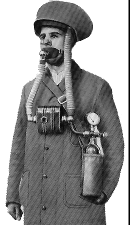 A head mounted counterlung style rebreather as opposed to the butt mounted type. One novel idea was
to build head mounted bags in the shape of Mickey Mouse ears. Jason also considered chest mounted bags
in the shape of breasts but now he has a working rebreather he doesn't have to fantasize as much ;)
A head mounted counterlung style rebreather as opposed to the butt mounted type. One novel idea was
to build head mounted bags in the shape of Mickey Mouse ears. Jason also considered chest mounted bags
in the shape of breasts but now he has a working rebreather he doesn't have to fantasize as much ;)
The Scrubber.
The scrubber is made from 150mm PVC sewer pipe. On my unit I have attached an end cap with two through hull fittings. gas flows in via one and is carried to the bottom of the scrubber, through the scrubber bed via a piece of clear rubber tube used in beverage transport and available from any hardware store. the gas then filters up through the scrubber bed and comes out through the other fitting. The scrubber bed is held between two plates of stainless mesh which are connected by long stainless rods and fastened with wing nuts. Springs are placed between the wing nuts and the mesh to keep the bed compacted and overcome and settling of material. There is an empty space at the bottom of the scrubber for water to collect should it enter the scrubber and the scrubber bed is kept up from this by a spacer made from an offcut of 150mm PVC pipe. For access to the scrubber bed I have used a screw on end fitting on the bottom . Jason's scrubber is made from the same materials however , because his lies horizontal, he has the inflow on one end and the outflow pipe on the other. The scrubber bed is held in place with pieces of scuba tank mesh cut to size and a large spring that lies between the end cap and the mesh keeps tension on the bed. He has also used two rightangle irrigation fittings to direct the hoses up over the shoulders.
The Mouthpieces.
The mouthpieces have been thrown together from various bits and pieces and were the hardest part to build. Mine is a conglomeration of PVC fittings which I have cut and attached using silicone and PVC glue. Hose barbs are attached at each side and these also hold the one way valves in place. Another PVC t piece type fitting was cut and melted and shaped and attached so that a scuba reg mouthpiece could be attached. I would guess that the mouthpiece is almost 70% silicone, 30% PVC and 100% luck. It could fall apart at any moment and there is no option for closing it off to allow for removing the mouthpiece underwater (or anywhere near water for that matter). For this reason OC bailout is always at hand, Hogarthian style, with a short hose hanging around my neck on a piece of inner tube. Jason also made full use of the I Ching and Chaos theory to construct his mouthpiece. His one way valves have been attached by hand moulding a fiberglass sheath on each end. To counteract the buoyancy problems of the lightweight PVC he has carefully and neatly (NOT) wrapped some lead flashing around it.
The Hoses.
Various hoses have been used. Currently I have hose available from most industrial safety equipment suppliers which runs between the mouthpiece and bags. The bore is not as big as I would like although I have recently found a similar part from a different company that is larger. The hose from the bags to the scrubber is from a ship chandler and is apparently normally used for refueling or fuel systems on boats. This was really cheap but the bore size resulted in buoyancy problems and when used from the mouthpiece to bags it floated up pulling on the mouthpiece, getting in my face and generally looking uncool. Jason has opted to use radiator hose between the scrubber and bags however this has no flexibility so it cannot be used between the mouthpiece and bags.
Click the eyes to see Home Made Rebreathers at work
Click here to go
 After the Dive -Above water shots of the D.E.A.D.
Other bits.
The whole thing is simply attached to an old BCD backplate and harness and the tanks are similarly strapped beside the scrubber. On Jason's unit he has attached it to a diveright backplate and wings using stainless downpipe clamps available from any hardware supplier. The dives have included CC dives on O2 as well as SC on various nitrox mixes.
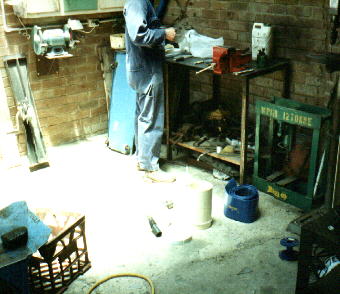
The O2 clean room with me hard at work building my second rebreather.

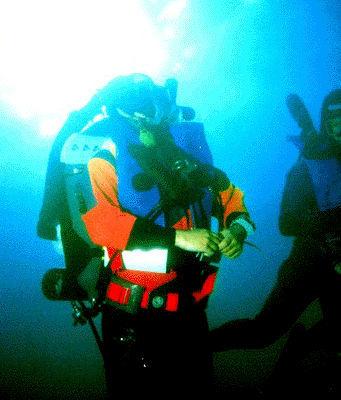
Ask the A.A.R.G.

 Back to Main Page